Introduction to the review
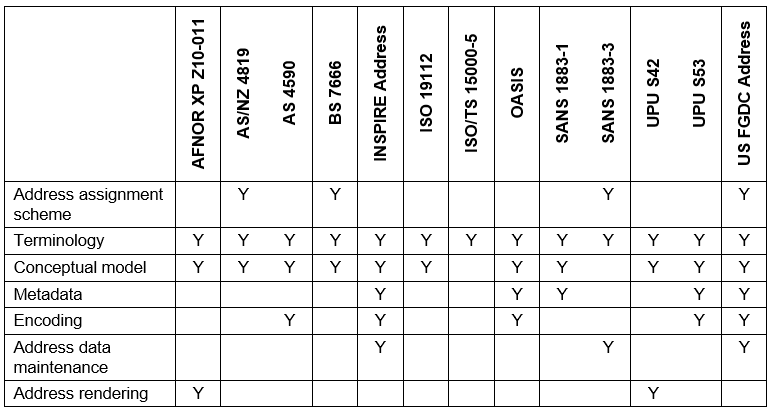
Standards support address data interoperability. There are different levels of interoperability, different business sectors where standards are implemented and different regions of applicability (national, regional, international). Some address standards support interoperability through the transfer and exchange of address data in a standardized encoding or format, while others support it through the specification of a standardized address assignment scheme. The differences between standards are reflected in the different ways in which the reviewed standards deal with address standardization. Refer to Table below. The reviewed standards facilitate address interoperability through one or more of the following, each of which is discussed in subsequent clauses:
- An address assignment scheme identifies the components that make up an address and describes how values are assigned to these components, i.e. how addresses are assigned in the physical world.
- Terminology (terms and definitions) that is used to describe the address assignment scheme and/or concepts in the conceptual model.
- A conceptual model that describes addresses, i.e. the meaning of concepts and relationships between them. Typically, an address is described as a combination of components or elements, often comprising a hierarchy. Some standards include address classifications (address types). The conceptual model usually reflects the address assignment scheme that is in use in the physical world.
- Metadata defines address-specific metadata that provides information about the address data, such as the custodian, lifespan, status, etc. Metadata is used during exchange and maintenance of address data.
- An encoding of the conceptual data model, i.e. the format to be used in data files or electronic messages when exchanging one or more address data records, which could include metadata.
- Address data maintenance, such as address data quality management, address life cycles and address aliases. Maintenance is based on the conceptual model.
- Specifications for the rendering of addresses for display on mail items, forms, maps, etc. The rendering rules are based on the conceptual model.
NOTE The complete scope statements of the reviewed address standards and a review of these scope statements are provided in ISO/TC 211 N 3188.