The Scope, or objective, for Workgroup 4 of TC 130 is “Development and review of ISO Standards and other document in the area of media and materials used within the overall scope of ISO TC 130”. We interviewed Tadanobu Sato, convenor (chairman) of the group.
Question: What areas of print production does the workgroup cover?
Answer: Working Group 4 (WG4) of ISO/TC 130 cover materials used in printing. This includes inks, substrates (paper, film, textiles) printing plates etc.
Q: When did you start working in TC 130?
A: I started working within ISO in 2014 and the first international meeting I participated in was the meeting in Toronto in 2015. I accepted to be convenor for WG4 in 2024. In my work for Fujifilm I’m especially interested in the work of ISO TC 130 WG11 Sustainability, and the work on standards in WG4.
Q. What is the most used or most well known standard that the workgroup has published in your view?
A: For inks I would say it’s definitely the ISO 2834 series Laboratory preparation of test prints. Those standards has defined the characteristics of inks and so made it possible to define processes for how to optimise the printed result. Part 1 cover Paste inks, Part 2 Liquid printing inks and Part 3 Screen printing inks. in the future, ISO 22934 (Communication of offset ink properties) will also help printers and paper makers communicate key criteria for printing inks.
When it comes to printing plates the ISO 12635 standard Plate dimensions for offset printing is also a useful tool for printers to judge if a certain plate is fit for purpose.
In the future, ISO 24487 Evaluation methods for processless plates will be useful for printers when deciding on what plates are best for their production.
For substrates, in this case paper, the standard ISO 15397 Communication of graphic paper properties will help printers choose the best paper for their production.
Q. What new standards are you working on at the moment?
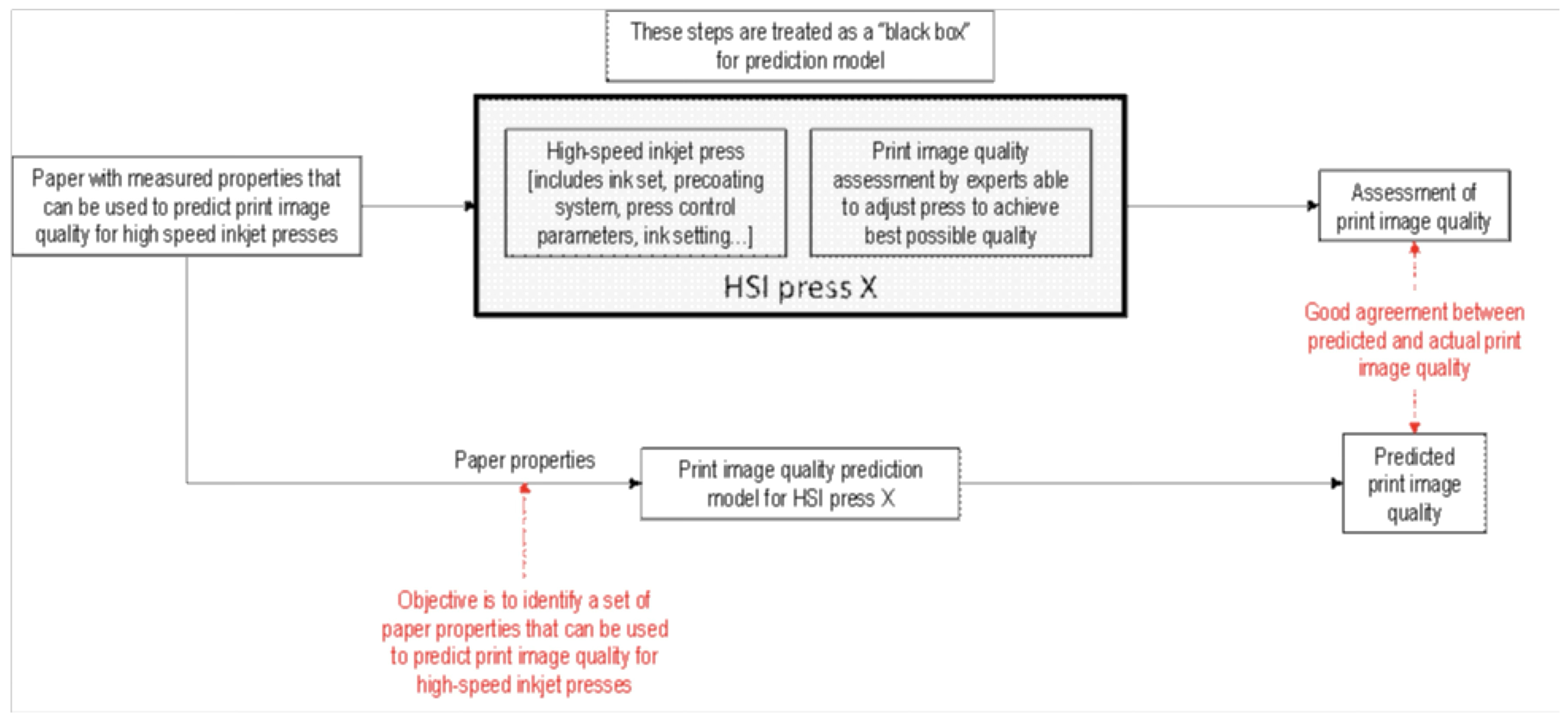
A: We are currently working on ISO TR 19312 Graphic Technology – Method for predicting print image quality of prints from high-speed inkjet printing system from combinations of paper properties. It’s a Technical Report, not an international standard, which describes a method and and procedures for predicting print image quality using high speed inkjet printing systems. The market share of High-speed inkjet printing systems is growing fast at the moment and this technical report will help vendors and users of such systems to evaluate the achieved print quality.
Figure 1: “Black Box” approach to prediction of image quality. (Ctrl- or right-button-click to open image in full resolution)