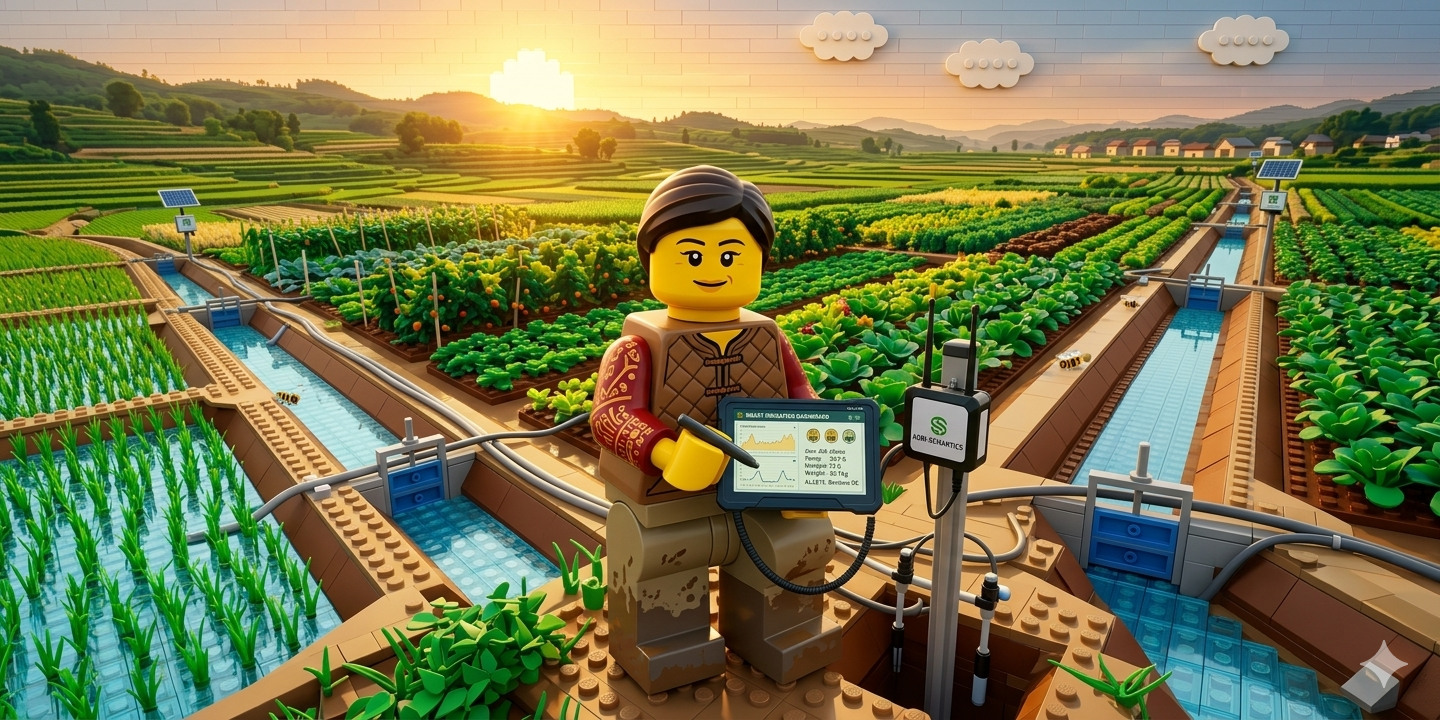
Irrigation accounts for approximately 70% of global freshwater withdrawals. Managing it well is one of the highest-leverage actions available to agriculture. Yet the data systems that could support better decisions are fragmented, often incompatible, and underused.
The pressure to produce more food with less water, lower energy, and reduced environmental impact is intensifying everywhere. Irrigation is central to that challenge — not simply because of the volume of water it uses, but because of its complexity. The environmental footprint of any irrigation decision depends on the source of the water, the energy embedded in its delivery, the soil and crop conditions in the field, and the cumulative impact on downstream catchments and groundwater systems. These tradeoffs are rarely visible at the point where decisions are made.
Why this matters — and why now
At the same time, irrigation is becoming increasingly data-rich. Soil moisture sensors, weather stations, satellite-derived crop stress indicators, variable-rate application systems, and remote-controlled valve networks are all generating information that could transform how irrigation is planned, applied, and monitored. The barrier is not technology. Rather, it is the absence of agreed standards for how that data should be structured, labelled, and exchanged between systems and stakeholders.
Some foundation exists: the ISO 7673 series of standards addresses high-level field and system data, and the ISO 21622 series covers device-level control. But the gap between device-level and farm-level or district-scale decision-making remains largely unaddressed. AHG 12 exists to close that gap.
"Smart irrigation is not about more sensors. It is about ensuring the data those sensors produce can flow seamlessly — from field to farm manager, from water authority to equipment supplier, from agronomist to regulator — in a form that supports real decisions."
What the standards will make possible
The work of AHG 12 will produce data models, controlled vocabularies, and interoperability interfaces for smart irrigation systems. The use cases below illustrate where that value lands across the full stakeholder community.
For farmers and irrigation managers
- Combine data from soil sensors, weather forecasts, crop models, and irrigation hardware (regardless of manufacturer) into a single, coherent view of field water status and crop demand.
- Receive irrigation scheduling recommendations that are grounded in real-time field data and can be acted on directly through standard control interfaces, without manual re-entry between systems.
- Document irrigation applications in a standardised format that satisfies on-farm record-keeping requirements and supports traceability claims downstream in the supply chain.
- Access district- or regional-level water allocation data through standard APIs, enabling farm-level planning to be informed by actual supply availability rather than estimates.
For irrigation equipment and technology suppliers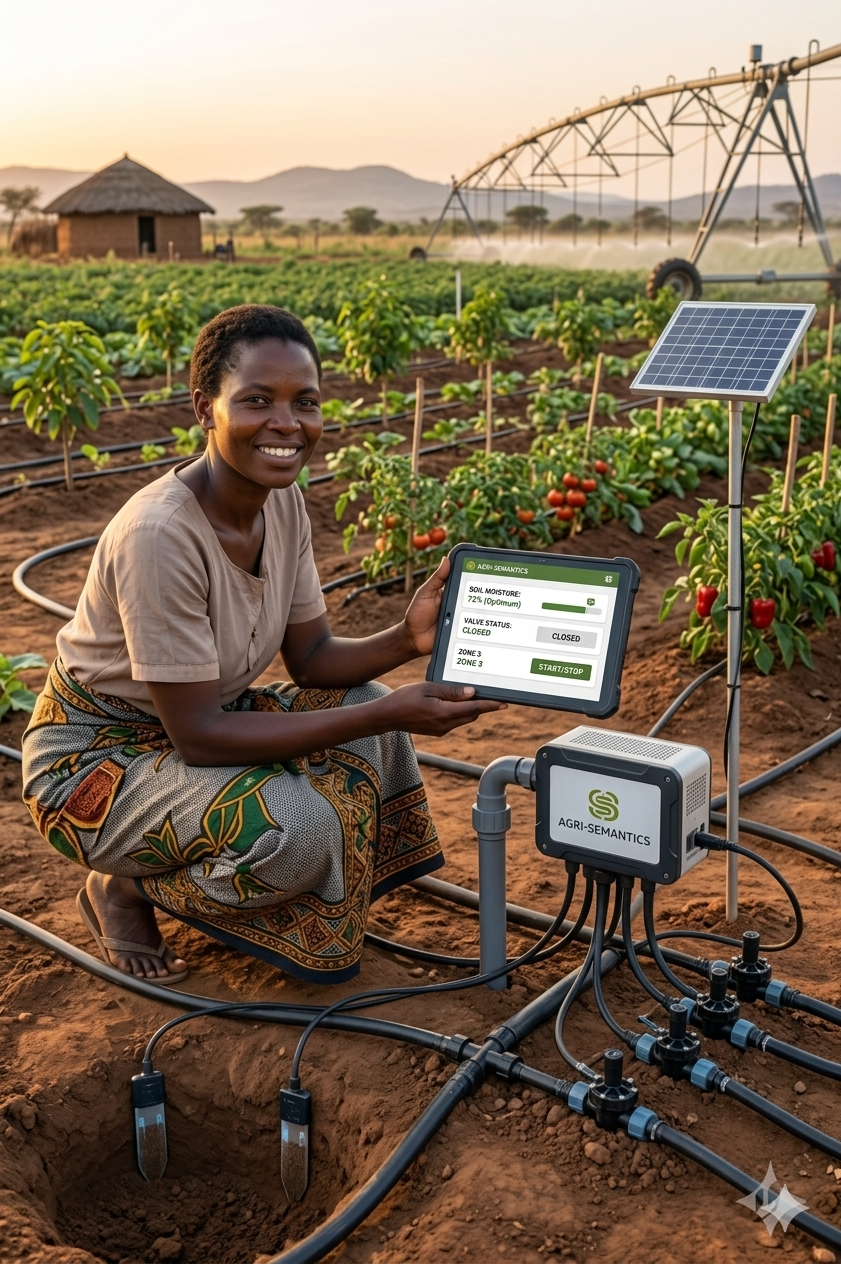
- Design sensors, controllers, and application systems against a stable, internationally recognised data standard, reducing the integration overhead required to connect with farm management platforms, advisory services, and water authority systems.
- Expose device data and accept control commands via standard interfaces, making products interoperable with any platform that conforms to the standard and broadening the addressable market without proprietary connector development.
- Build decision-support tools and scheduling algorithms on a common data foundation, enabling those tools to operate across diverse equipment configurations without bespoke adaptation.
For water authorities and irrigation district operators
- Receive standardised water use reports from farms and on-farm systems, enabling district-scale water accounting, allocation enforcement, and aquifer management without relying on self-reported estimates.
- Publish water availability, quality, and allocation data through standard APIs so that farm-level irrigation management systems can incorporate supply constraints automatically.
- Support multi-objective optimisation across a district (balancing crop productivity, environmental flow requirements, energy costs, and drought resilience) using a common data model that connects individual farm decisions to system-level outcomes.
- Demonstrate compliance with national and transboundary water-use commitments through structured, auditable data records tied to UN SDG indicators for water (SDG 6) and responsible consumption (SDG 12).
For input suppliers and agronomists
- Integrate crop water demand models and fertigation recommendations with irrigation scheduling systems through standard data interfaces, reducing duplication and improving the coherence of advice delivered to growers.
- Access standardised records of past irrigation events, soil moisture trajectories, and applied volumes to calibrate recommendations and evaluate outcomes at scale.
- Support sustainability certification claims (water footprint, carbon intensity, responsible sourcing) with verifiable, structured irrigation records that flow through the supply chain without manual translation.
For processors, retailers, and supply chain buyers
- Receive machine-readable irrigation and water-use records linked to specific field-level production lots, enabling water footprint claims and sustainability disclosures to be grounded in verified operational data rather than averages or proxies.
- Incorporate water-use transparency into supplier qualification and procurement standards, using a common data vocabulary that works across geographies and farming systems.
- Respond more rapidly to regulatory requirements around water-related environmental disclosures as these develop in key markets.
For regulators and researchers
- Access aggregated, standardised irrigation data at district, basin, and national scale to monitor compliance with allocation regimes, assess the impact of policy interventions, and track progress against sustainability targets.
- Analyse cross-regional datasets on irrigation practice, water source, energy use, and outcomes to develop and validate optimisation models that can be deployed at scale.
- Build environmental impact assessments and water accounting frameworks on a consistent data foundation, reducing the cost and uncertainty of translating farm-level records into basin-scale conclusions.
How the work will proceed
AHG 12 operates within ISO/TC 347 — the technical committee for data-driven agrifood systems — and will develop one or more New Work Item Proposals (NWIPs) for full international standards. Its scope deliberately builds on and complements existing work: the semantic framework of WG 1, the observations and measurements vocabulary of ISO 7673-2, the message structures of AHG 8, and the field boundary model of AHG 10. This is not a parallel effort, it is the next layer of a coherent, interconnected standards architecture for smart farming.
The group is co-convened by Prof. Dr. Wenyong Wu (China Institute of Water Resources and Hydropower Research; Secretary General, Chinese National Committee on Irrigation and Drainage) and Dr. Charles Hillyer (Director, Center for Irrigation Technology, California State University Fresno; Project Leader, ISO 7673). Together they bring deep expertise in both the technical and standards dimensions of irrigation data, and strong connections to the international irrigation community.
Participation is open to all members of ISO/TC 347 and its liaison organisations. Engagement from ISO/TC 23/SC 18 (Irrigation and drainage equipment and systems) and international bodies including ICID is actively sought. The AHG aims to have draft NWIPs ready for comment and vote at or before the March 2027 plenary, at which point work transitions to a dedicated working group.
AHG 12 does not prescribe irrigation technologies or practices. It defines the shared data infrastructure that allows any technology — whether a simple soil probe or a fully automated variable-rate system — to contribute to better, more transparent decisions across the entire water-food system.
Get involved
The standards that emerge from AHG 12 will be most useful when they reflect the full diversity of irrigation practice, from smallholder drip systems to large-scale centre-pivot operations, from arid-region groundwater users to humid-climate supplemental irrigators. If you are a grower, equipment manufacturer, water authority, agronomist, processor, or researcher with a stake in how the irrigation sector uses data, your participation matters.
ISO/TC 347 member body representatives can engage through their national standards body. Industry organisations and liaison bodies are encouraged to contact the TC Secretariat directly.