
The bee products industry is growing, data-rich, and ripe for transformation. What it has lacked, until now, is a common language.
Global demand for honey, wax, pollen, propolis, and royal jelly is rising sharply. The market reached an estimated US$11.75 billion in 2024 and is projected to grow to nearly US$19 billion by 2032. Yet behind this growth lies a sector under pressure: colonies threatened by parasites, disease, pesticides, and habitat loss; supply chains vulnerable to adulteration and mislabeling; and a proliferating array of digital monitoring tools that cannot talk to one another.
Why this matters — and why now
At the same time, a transformation is underway. Smart hive sensors, telemetry platforms, laboratory information systems, traceability apps, and breeding databases are all generating data that could improve decisions at every point in the chain — from the apiary to the retail shelf. The barrier is not technology, it is the absence of agreed standards for how that data should be structured and shared.
AHG 11 has been created to work towards removing that barrier.
"The goal is not to standardise technology — it is to standardise the common language that allows different technologies to work together across the full value chain."
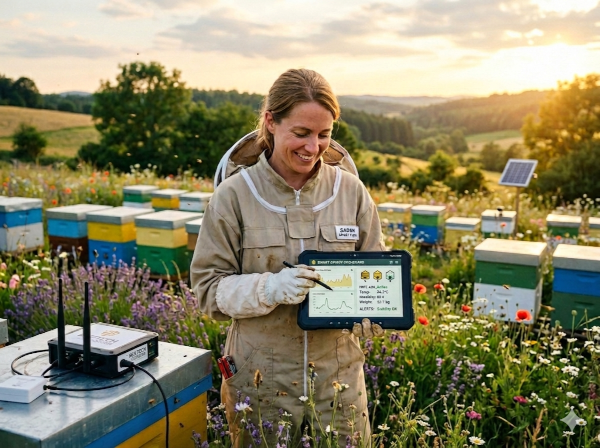
What the standards will make possible
The work of AHG 11 will focus on data models, controlled vocabularies, and interoperability interfaces, which form the foundational layer that unlocks concrete benefits across the entire bee products community. The use cases below illustrate how this will create value at every step in the produce chain.
For producers and beekeepers
- Enable aggregation of telemetry from any combination of sensors and scales into a single coherent view of colony health, eliminating the locked-in dependency on a single device vendor.
- Record disease observations, treatments, and veterinary histories in a standardised format that supports responsible chemical use and meets regulatory requirements in export markets.
- Log pollination service contracts, hive movements, and performance indicators digitally, reducing disputes and improving the evidence base for fair payment.
- Access breeding data and queen performance records in a format that travels across breeders and regions, enabling more informed genetic decisions.
For input and equipment suppliers
- Design devices and sensors against a known and stable data standard, reducing the cost of integration and broadening the addressable market.
- Expose data via standard APIs rather than proprietary connectors, making products interoperable with any platform that conforms to the standard.
- Assemble catalogues of reference data (e.g. chemicals and treatments) aligned with shared vocabulary standards, enabling automatic withdrawal-period checking and export-compliance flagging within beekeeper management systems.
For packers, processors, and the retail chain
- Receive standardised harvest batch records from beekeepers and import them directly into packing management systems, eliminating manual re-keying and its associated errors.
- Link laboratory test results (moisture, HMF, pesticide residues, antibiotic screens) to specific product batches in machine-readable form, enabling automated compliance checking and faster shipment clearance.
- Support certification claims (e.g. organic, monofloral, geographic indication) with verifiable, machine-readable data, enabling its direct exchange with certification bodies, reducing audit burden and strengthening brand credibility.
- In a recall or contamination event, identify and isolate affected lots rapidly by tracing them back through a standardised, end-to-end traceability chain.
For regulators and certification bodies
- Receive structured, comparable incident reports (e.g. pesticide exposure events, colony losses, contamination incidents) that support faster investigation and evidence-based policy.
- Aggregate laboratory results across operators and laboratories to identify systemic residue or disease risks before they become crises.
- Verify certification claims against a live machine-readable record rather than paper documentation, reducing fraud risk and audit cost.
For consumers
- Scan a QR code and access genuine, structured traceability data linking the product in hand to the apiary, the harvest date, the quality test results, and any relevant certification, not just a marketing page.
- Greater confidence that origin, floral source, and production practice claims are backed by verifiable, standardised data rather than unverifiable assertions.
How the work will proceed
AHG 11 operates within ISO/TC 347 — the technical committee for data-driven agrifood systems — and will develop one or more New Work Item Proposals (NWIPs) for full international standards. Its approach is deliberately aligned with parallel ISO work: the semantic framework of AHG 2, the livestock data model of AHG 6, the document standards of AHG 8 and AHG 9, and the field boundary work of AHG 10. The aim is a coherent set of standards that positions apiculture data within the broader agrifood information system, not as an isolated silo.
The group is co-convened by Dr. Xuan Li (Committee Manager, ISO/TC 34/SC 19 Bee Products) and Dr. R. Andres Ferreyra (Chair, ISO/TC 347). Participation is open to all members of ISO/TC 347, ISO/TC 34/SC 19, and TC 347’s liaison organisation representatives. Engagement from international apiculture organisations including Apimondia, BeeLife, and national beekeeping associations is actively sought.
The AHG aims to have draft NWIPs ready for comment and vote at or before March 2027, at which point work will transition to a dedicated working group.
AHG 11 does not prescribe what technologies the industry should use. It defines the common data structures that allow any technology — today's and tomorrow's — to contribute meaningfully to the whole.
Get involved
Standards are most useful when they reflect the reality of the sector they serve. If you are a beekeeper, equipment manufacturer, packer, laboratory, certification body, retailer, or researcher with a stake in how the bee products value chain uses data, your participation in AHG 11 matters.
ISO/TC 347 member-body representatives can engage through their national standards body. Industry organisations and liaison bodies are encouraged to contact the TC Secretariat directly.