AHG 12 inaugural meeting and open invitation

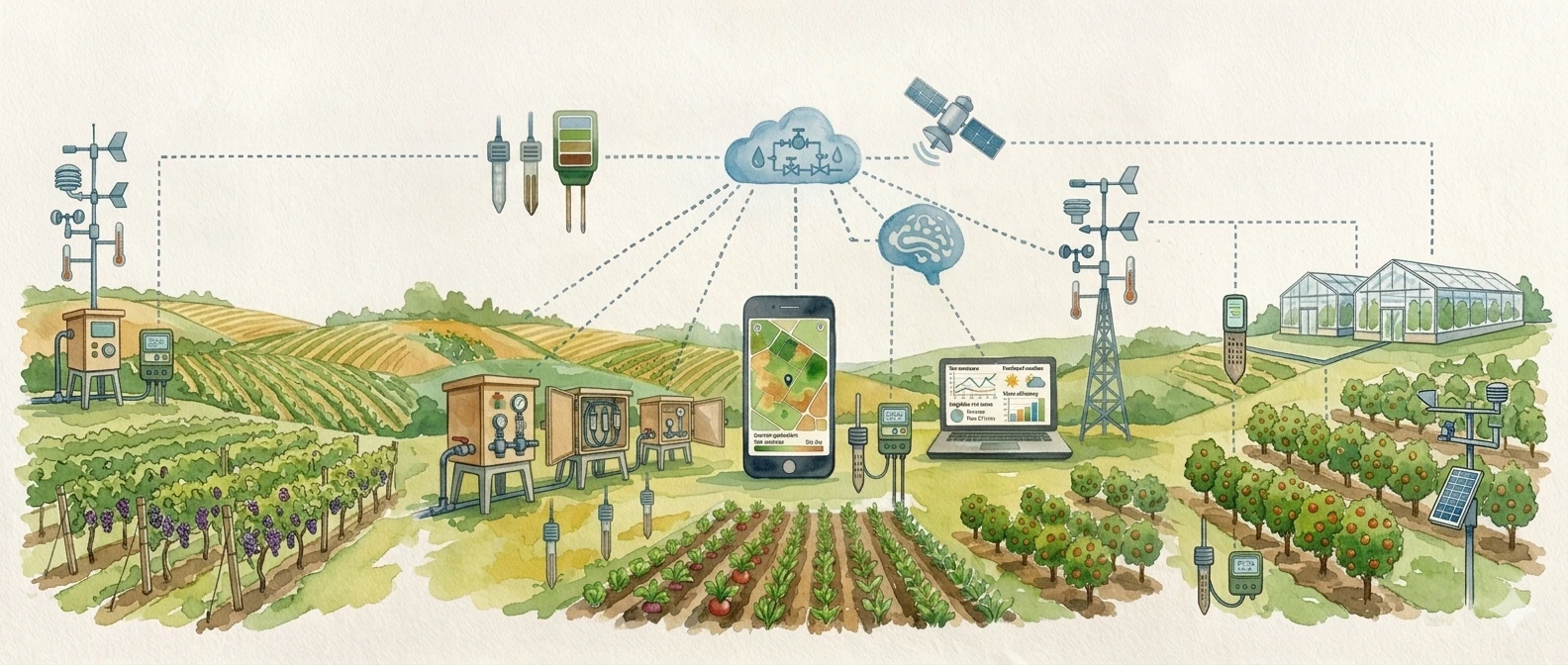
SmartIrrigationWide.webp

Enabling smart irrigation

On-line
Tuesday June 30 - 08:30 New York / 14:30 Berlin / 20:30 Beijing / 21:30 Tokyo
Wednesday July 1 - 00:30 Auckland

If you are a member of TC 347, please register via the ISO portal.
Otherwise, open registration is via Zoom at https://syngenta.zoom.us/j/99765063238

Global agrifood sustainability centres heavily on managing irrigation water as an increasingly scarce resource. Each drop carries environmental tradeoffs and embedded energy dictated by its source and provenance. Explicitly tracking the origin and disposition of irrigation water is vital to empower data-driven decisions and quantify alignment with key UN Sustainable Development Goals.

Lack of data interoperability in irrigation is a critical barrier to progress. Whilst irrigation benefits from foundational system (ISO 7673) and device (ISO 21622) interoperability - these are insufficient for optimization at farm or regional scale.

This group will bridge the gap by developing the additional standards required to unlock seamless data interoperability, empowering producers to maximize water efficiency and reduce agriculture's environmental footprint.

Rationale

  • There is an increasing push worldwide to improve the sustainability of agricultural and food production. This includes optimization of the use of irrigation water, one of the most impactful components of the environmental footprint of agriculture.
  • As pointed out by the ISO Strategic Advisory Group for Smart Farming final report’s Recommendation 3.4.21, irrigation water is an increasingly valuable and scarce resource.
    Moreover, irrigation water can rarely be used without some kind of environmental impact and/or tradeoff. This impact is contingent on the water’s source (e.g., groundwater, snowmelt, runoff, grey water, etc.) and provenance (where/how the water was received will translate into different embedded energy), so unambiguously representing the sources, origin / provenance and disposition (i.e., where it is applied and how it is used) of different irrigation water options would be a helpful way of making these tradeoffs more explicit during operational decision-making. This would enable documenting and quantifying the sustainability of irrigation with respect to UN SDGs 1, 2, 6, 12, 13, 14 and 15, for example.
  • This is difficult, however, due to a lack of data interoperability among the different providers of information, consistent with what happens in multiple other segments of the agrifood industry. Irrigation has a comparative advantage with respect to other industry segments, however, in that the ISO 7673 series of standardization projects was initially developed by ISO/TC 23/SC 19 with high-level irrigation data interoperability (e.g., at the field or system level) in mind, and ISO 21622 was developed by ISO/TC 23/SC 18, aiming at controlling irrigation at the device (e.g., valve) level.
  • The abovementioned standards are not enough to implement data-driven irrigation optimization at the farm or broader scales. This will require additional standards, the object of this proposal.

Proposed Terms of Reference

Ad hoc group 12 aims to take the first step in the direction of developing standards to enable smart (i.e., data-driven, multiobjective-optimization-oriented) irrigation, by creating an ad hoc group (“The AHG”) within ISO/TC 347. The purpose of this ad hoc group is to develop one or more (as determined by The AHG) new work item proposals (NWIPs).

The scope of the proposed ad hoc group includes:

  • Producing a conceptual framework for understanding smart irrigation as a form of datadriven decision-making,
  • Helping the AHG and TC 347 understand how existing standards are inadequate and identifying specific standards that the industry needs
  • Drafting and presenting one or more new work item proposals (NWIPs), as an eForm 4, accompanied by a draft standard. [This could be preceded by a technical report (TR) addressing the first two points.]
  • Design of controlled vocabularies of pertinent features of interest, observed properties, observation and measurement methods (both in-field and laboratory), and metadata variables of relevance to smart irrigation, ensuring their compatibility with existing ISO 7673-2.
  • Draft of a data model and standard messages to represent the documents used in smart irrigation decision-making at the scales of interest, seeking to build upon ISO 7673-3.
  • Gap-checking the business capability model derived by IWA 47 from the one presented in the SAG-SF final report subclause 4.3. This gap-checking should identify additional support or enabling capabilities that could be added to the model to enable smart irrigation.
  • Identifying and harmonizing key terms and definitions with the glossary being initiated by IWA 47, to be passed on to TC 347.
  • Selecting a set of use cases of interest and harmonizing them with the use cases identified by IWA 47.
  • Identifying key business capabilities relevant to smart irrigation and harmonizing them with the business capability model under construction by IWA 47.
  • Designing, planning, and identifying opportunities for field tests and pilots of the standard(s) to be developed as a result of the NWIP(s) developed by The AHG.
  • This standard would optimally be developed with contribution from experts from TC/23 SC 18 (Irrigation and drainage equipment and systems) and liaison representatives from relevant international organizations; pursuing participation from these organizations is in scope.
Dr. Wenyong Wu, PhD
Co-Convenor AHG 12: Smart irrigation
China Institute of Water Resources and Hydropower Research

China
Charles Hillyer, PhD
Co-Convenor AHG 12: Smart irrigation
Center for Irrigation Technology, California State University, Fresno

USA