Overview
Farming and food producers in general have always looked for more efficient ways to grow food and raise livestock, but their task is becoming increasingly difficult. Producers and myriad other agrifood stakeholders (such as processors or food manufacturers) pursue often-competing objectives such as profitability, sustainability, and the freedom to operate, under an ever more challenging set of constraints such as climate change, regulatory pressure, changes in consumer preferences, increasing cost of inputs, commodity price volatility and an increasingly complex geopolitical situation. The availability of critical resources like fertilizers and irrigation water is uncertain, weather-related stresses are increasingly extreme and unpredictable, and market signals are ambiguous at best.
Given the critical role of data and its exchange in this context, agrifood systems today:
- are increasingly data-driven
- increasingly need to base decisions on sound scientific principles and generally accepted good agricultural practices
- involve multiple stakeholders in the value chain
- e.g., producers, their advisors, equipment manufacturers, post-harvest sector, customers, regulators, to name a few
- must adapt to a volatile, uncertain, complex and ambiguous world
- e.g., the prices of both crop inputs and harvested commodities are volatile, yields and the availability of resources like irrigation water are uncertain, growing a crop is getting increasingly complex, and market signals are ambiguous at best.
Scope
ISO/TC 347 works towards the standardization of data and related topics in the field of agricultural and food systems (which, together, we refer to as "agrifood systems"). We seek to enable comprehensive, data-driven, multi-objective decision-making, in the context of a complex and changing world. This includes, in particular, addressing interoperability challenges such as:
- uniform terminology, semantic resources (such as controlled vocabularies and ontologies) and semantic infrastructure, henceforth collectively referred to as "agrisemantics";
- procedures and technologies that enable the effective use of data to address the complexity and diversity of challenges within agrifood systems;
- sustainability models, metrics and data in agrifood systems;
- livestock activities data management;
- greenhouse, controlled environment, and urban farming.
The scope also includes data-related concerns in value chains involving animal feed, energy, fiber and other specialty crops, as well as integrated pest management and enabling traceability of food ingredients of agricultural and non-agricultural origin.
The scope excludes: standardization covered by ISO/TC 34 "Food Products", ISO/TC 23/SC 19 "Agricultural Electronics", ISO/TC 211 "Geographic information / Geomatics", ISO/TC 154 "Processes, data elements and documents in commerce, industry and administration", and ISO/TC 331 "Biodiversity". It does, however, recognize the strategic importance of pursuing opportunities for close collaboration with other technical committees, and providing a data management resource to relevant committees where appropriate.
Strategic Objectives Map
ISO/TC 347’s strategic objectives are organized to enable this vision, and to do so in the context of the set of 49 recommendations that were provided by the ISO Strategic Advisory Group for Smart Farming (SAG-SF). We arranged them in the form of a strategy map, influenced by the Balanced Scorecard method of strategic performance management. As in the Balanced Scorecard method, the strategy map includes four different perspectives or layers, in our case these are "Learning & growth", "Internal processes", "Deliverables", and "End-users".
Each layer is dependent on the ones beneath it and forms the foundation for the one above. The map, below, shows the elements of our strategy and the complex set of interactions which tie the objectives to one another and which support our ultimate goals of delivering to our end-users.
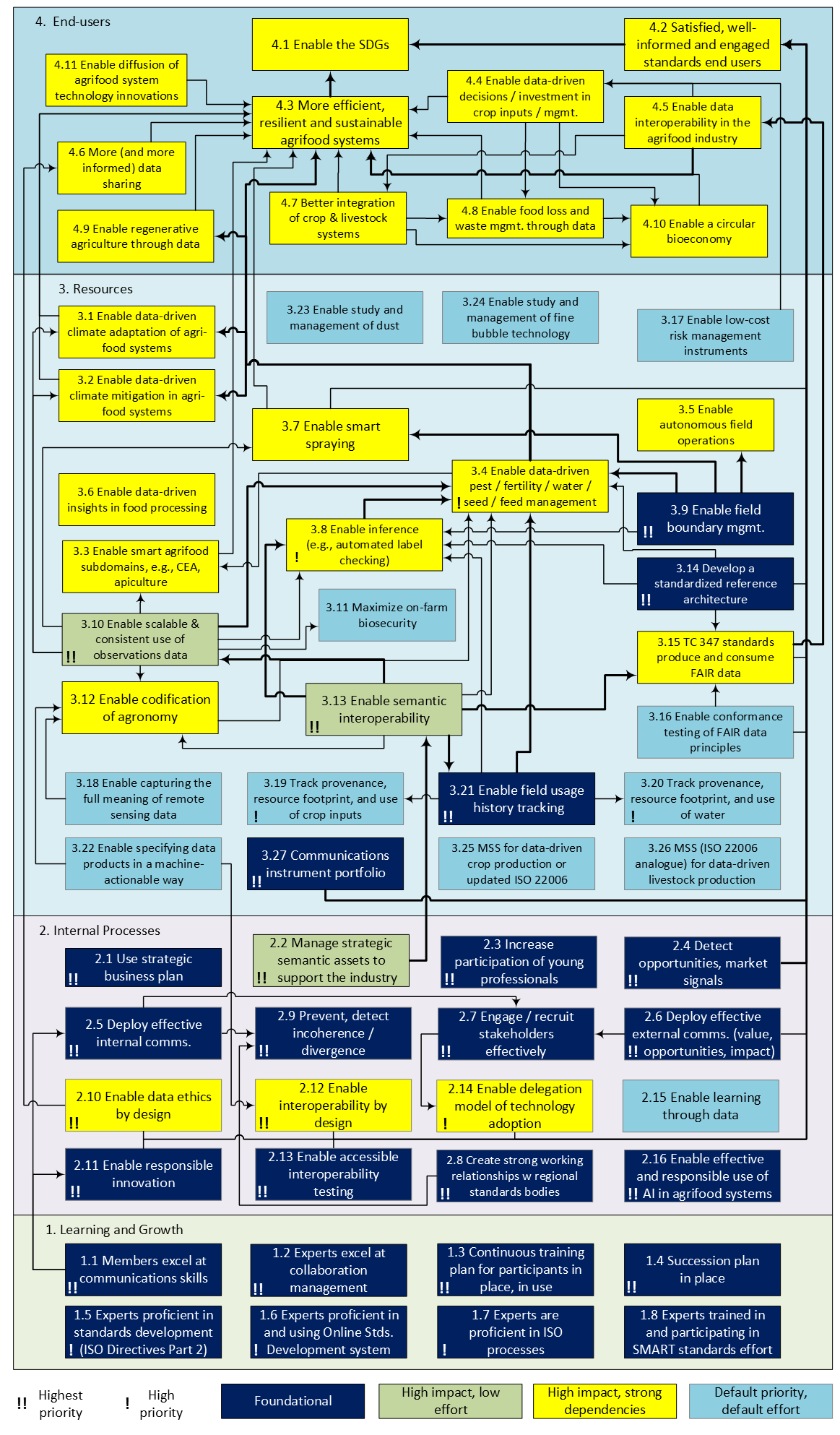
NOTE 1: The term "data-driven" is frequently used in the context of strategic decision-making; it denotes that decisions are based on the analysis and interpretation of data, as opposed to, say, opinions or tradition only.
NOTE 2: The multi-objective nature of agrifood systems decision-making includes aspects such as maximizing profitability, sustainability, and compliance.
NOTE 3: In addition to the specific in-scope topics listed above, enabling data-driven decision-making in arable crops and the field operations, supply chain operations, and logistics that involve them, i.e., the default target of digital agriculture, is also in scope.
Downloads
Get the latest version of the strategic business plan →
Published: March 2026 | Edition: 1
