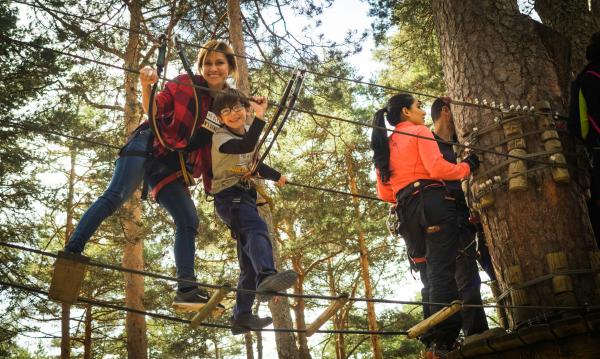
Towards safer, more reliable adventure challenge facilities
Building on existing national experience for both outdoor and indoor facilities, the main objectives of ISO/AWI 25037 are to define essential and specific requirements that supervised adventure challenge facilities with collective fall protection while providing the thrill of the challenge, must meet structural integrity coupled with reduction of frequency and severity of injuries. The standard is intended to: provide a clear framework for design and construction, including material selection and structural integrity define necessary inspections, modifications and maintenance procedures once facilities are installed and setting out requirements for fall and impact protection systems that help manage risk while enabling meaningful challenge and play incorporating the content of ISO 4980. Altogether, the standard aims to strike a balance between the benefit of adventure and reduction of injury severity, addressing public health and injury reduction concerns with clearly documented and communicated risks while preserving the spirit of challenge and outdoor recreation.
Supporting safe, inclusive and nature‑based recreation for all ages
Adventure challenge facilities have evolved over recent decades from small sites where adventurers gathered to test and improve their skills into larger, often commercial attractions. Today, they range from straightforward family activities to more demanding challenges that require skill development and confidence on the part of the user.
Many of these facilities are located in family destinations and nature‑oriented settings, and are designed to build both physical and mental skills, allowing for continued improvement and further challenge. Because they are open to the public and often involve elevation, challenge and supervision, there is a clear need for structural requirements, suitable methods of engagement, fall prevention, acceptable injury thresholds, and robust inspection and maintenance regimes.
Working Group
ISO/AWI 25037 “Sport and recreational facilities — Supervised adventure challenge facilities with collective fall protection — Design, construction, operation, inspection and maintenance requirements” is being developed in ISO/TC83/WG 8 “Playspaces” with Tom Norquist as WG-Convenor. The project leader is Rolf Huber.
Scope of the standard
This document sets out the requirements for supervised adventure challenge facilities, irrespective of height above the ground, that use collective safety systems and are intended for intergenerational recreation where participants are not placed in a harness or other safety device and have free movement.
It includes requirements for the design, construction, operation, inspection and maintenance of adventure challenge facilities.
The document specifies requirements for the materials used in the manufacture of components, systems and collective fall protection, their structural integrity, their ability to meet their intended use and the design loads that can be expected during reasonably foreseeable misuse.
It also sets out requirements for fall and impact protection systems designed to dissipate energy and to limit the velocity and acceleration of falling persons or impacting objects.
This standard is not applicable to: high ropes where harnesses and safety devices are used (e.g. EN 15567) playgrounds (e.g. EN 1176 series, ASTM F1487, CSA Z614, SS457, AS4685 series) mechanically driven equipment (e.g. EN 13814, amusement rides and devices), parkour equipment (e.g. EN 16899), outdoor fitness equipment (e.g. EN 16630, ASTM F3101).
Towards safer, more reliable adventure challenge facilities
Building on existing national experience, the main objectives of ISO/AWI 25037 are to define essential and specific requirements that supervised adventure challenge facilities with collective fall protection must meet to ensure structural and operational safety. The standard is intended to: provide a clear framework for design and construction, including material selection and structural integrity define necessary inspections, revisions and maintenance procedures once facilities are installed set out requirements for fall and impact protection systems that help manage risk while enabling meaningful challenge and play. Altogether, the standard aims to strike a balance between adventure and safety, addressing public health and safety concerns while preserving the spirit of challenge and outdoor recreation.
Next steps and call for experts
The Working Group has started its work on ISO/AWI 25037, and further interested experts are welcome to join and support the development of the standard.
Contribution to the UN Sustainable Development Goals
The project contributes to several United Nations Sustainable Development Goals (SDGs), including:
Goal 3 – Good Health and Well-Being for People: By promoting physical activity and recreation, these facilities support physical health, mental well‑being and stress reduction.
Goal 4 – Quality Education: Structured challenges and supervised activities provide platforms for experiential learning, building teamwork, resilience and problem‑solving skills.
Goal 5 – Gender Equality: Inclusive designs and programming encourage participation by all genders, supporting equitable access to recreational opportunities.
Goal 9 – Industry, Innovation, and Infrastructure: The design and construction of these facilities foster innovation in materials, safety technologies and recreational infrastructure.
Goal 10 – Reducing Inequalities: By offering accessible adventure experiences in public and community settings, these facilities can help reduce inequalities in access to recreation.
Goal 11 – Sustainable Cities and Communities: Adventure challenge facilities can form part of sustainable urban and regional planning, providing eco‑friendly recreational spaces that integrate with natural or green areas and strengthen community engagement.
Goal 15 – Life on Land: By incorporating outdoor and nature‑based elements, these facilities can promote awareness and conservation of natural environments and support biodiversity‑friendly, environmentally responsible design practices.