CASE STUDY - ISO 21401 : 2018
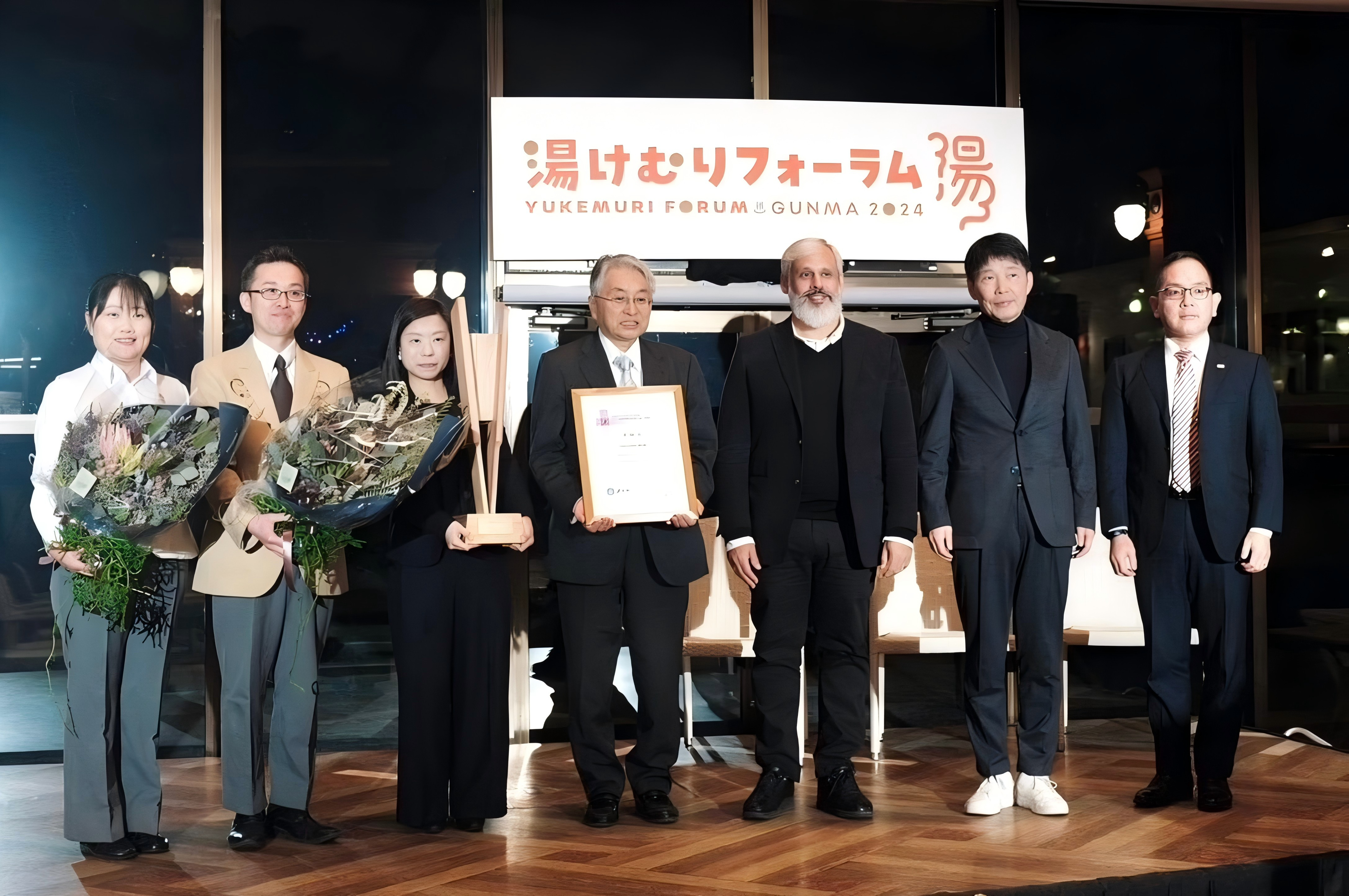
This article examines the implementation of ISO 21401 — the international standard for sustainability management systems (SMS) in accommodation establishments — at Hotel Village, operated by Nakazawa Village Co., Ltd., in Kusatsu Onsen, Gunma Prefecture, Japan, certified by J-VAC, in December 2024. The case demonstrates how a traditional ryokan-heritage property, located in a demographically declining rural community and carrying a history of civil rehabilitation proceedings, transformed its centuries-old cultural identity into a sustainable competitive advantage. Measurable outcomes include an operating profit margin that nearly doubled, a 37,5% reduction in workplace accidents, and energy and water consumption savings of 5 to 10%.
When Ancient Waters Meet Modern Standards: ISO 21401 at Hotel Village, Japan
Alexandre Garrido Convenor, ISO/TC 228 WG13 — Sustainable Tourism
1. Introduction: Resilience in Thermal Waters
There is a particular kind of resilience found in places that have served travellers for generations. Kusatsu Onsen, in the mountains of Gunma Prefecture, Japan, has been welcoming visitors since the Edo period. Its thermal waters — among the most acidic and mineralised in the country — have drawn pilgrims, physicians and weary travellers for centuries. It is here, in December 2024, that Nakazawa Village Co., Ltd., operator of Hotel Village — founded in 1967 — became one of the most compelling demonstrations yet of what ISO 21401 can do for a hospitality organisation.
As Convenor of the ISO working group that developed ISO 21401, I have observed its adoption across a range of contexts worldwide. But few cases illustrate its transformative potential as clearly as this one — not because the hotel is large or technically sophisticated, but because of the depth of alignment between the standard’s framework and the property’s own identity.
This article is organised around four central questions:
-
What distinguishes ISO 21401 from other sustainability approaches in the hospitality sector?
-
What real-world challenges does a regional property face on the implementation journey?
-
What concrete results — operational, financial and organizational — emerge from certification?
-
What lessons does this case offer to the global hospitality industry?
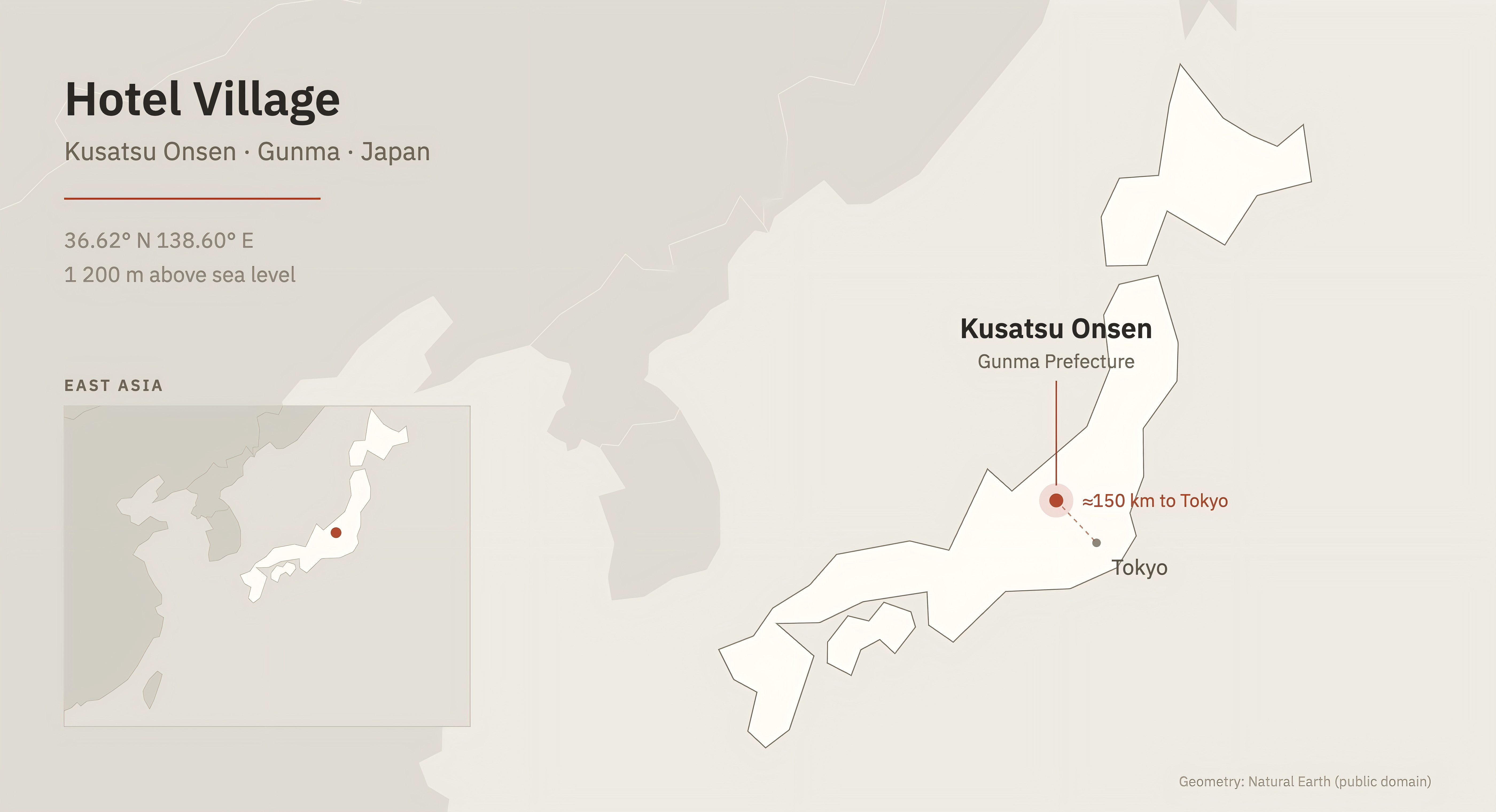
Hotel Village sits in Kusatsu Onsen, Gunma Prefecture — approximately 150 km north-west of Tokyo, at roughly 1200 m altitude. Geometry: Natural Earth (public domain).
2. ISO 21401: Origin, Architecture and Purpose
2.1 Origin and Genealogy
Before examining the Hotel Village case, it is worth briefly recalling what ISO 21401 is — and what it is not. Published in 2018, ISO 21401 Tourism and related services — Sustainability management system for accommodation establishments — Requirements specifies the environmental, social and economic requirements for implementing a sustainability management system (SMS) in tourist accommodation.
It grew out of ABNT NBR 15401, the Brazilian national standard that the hotel industry in Brazil had applied since 2006 — a standard shaped by extensive consultation with travel specialists, hoteliers, trade associations, NGOs, local communities, government bodies and development agencies. When ISO/TC 228 adopted it as the basis for an international standard, the intention was not to create a niche environmental label. The intention was to offer the accommodation sector a rigorous, commercially neutral and integration-ready management tool.
ISO 21401 will benefit accommodation facilities by strengthening their management and improving their reputation, while providing better-quality services to clients and improving relationships with suppliers, employees and the local community.
— Alexandre Garrido, Convenor, ISO/TC 228 WG13
2.2 Architecture and Integration
Critically, the standard is built on ISO’s High-Level Structure (HLS) — the same architecture used by ISO 9001 (quality management) and ISO 14001 (environmental management). This means it is not a standalone obligation, but a layer that integrates naturally into whatever management systems an organisation has already built.
The HLS ensures structural compatibility and allows organisations already certified under other ISO standards to leverage significant synergies when implementing ISO 21401, reducing both cost and the effort of adaptation.
The Three Dimensions of Sustainability in ISO 21401
ENVIRONMENTAL — Management of natural resources (energy, water, waste, biodiversity), emissions and local environmental impacts. In the context of Kusatsu Onsen, this encompasses stewardship of the thermal springs, the yubatake (hot water field) and the surrounding landscape.
SOCIAL — Relationships with employees, the local community, suppliers and guests. Covers wellbeing, diversity, local culture and the transmission of intangible cultural heritage.
ECONOMIC — Long-term financial viability, transparency, governance and value creation for stakeholders. Includes relationships with financial institutions and sustainable market positioning.
3. Hotel Village: Identity, History and Context
3.1 A Corporate Philosophy That Was Already ISO 21401
What struck me most when reviewing Nakazawa Village’s engagement with the standard was how little translation was required between their existing values and the standard’s requirements. Their corporate philosophy — “Providing comfort to those who arrive and happiness to those who depart” — is, at its core, a statement about sustainable guest experience. But it goes further.
The hotel explicitly frames its role in terms of the three traditional purposes of Japanese hot spring resorts:
- KYUYO (Recreation)
- HOYO (Wellness)
- RYOYO (Recuperation)
The hotel provides a space for mental and physical refreshment, facilitating rest and recuperation.
When examined through the lens of ISO 21401's three sustainability dimensions, the connection to the hotel's philosophy becomes unmistakable. On the environmental dimension, Kusatsu Onsen's defining resource is water — the mineralized thermal spring that flows through the yubatake (hot water field) at the town's heart. Responsible management of this natural resource, its temperature, flow rates, and the surrounding landscape that sustains it, is not an abstraction for Hotel Village. It is the foundation of the entire business proposition. On the social dimension, the hotel's emphasis on onsen wellness is inseparable from the living cultural tradition of Kusatsu itself — a tradition of communal bathing, regional cuisine, and the healing rituals of jikan-yu (timed bathing) that stretches back centuries. Preserving and transmitting that culture is a form of social sustainability. And on the economic dimension, the hotel's explicit is a direct response to what contemporary travellers are seeking. Meeting those needs through a distinctive, place-rooted offer, rather than a generic hotel experience, is sustainable economic positioning.
The distinctiveness of this case lies precisely here: the values were already present. ISO 21401 provided the structure through which to operationalize, verify, and continuously improve them.
3.2 Historical and Institutional Context
Founded in 1967, Hotel Village has a history that, paradoxically, reinforces the relevance of ISO 21401: the company entered civil rehabilitation proceedings in 2009 and completed the process in 2011. Located in Kusatsu Onsen — approximately 150 km north-west of Tokyo — the property inherits a hospitality tradition stretching back to the late Edo period, serving generations of visitors drawn to the unique therapeutic properties of its waters.
Certification by J-VAC (Japan Value-Added Certification), a Japanese conformity assessment body specializing in management system certification for the industry and tourism sectors, in December 2024, closes that cycle and opens a new organizational chapter grounded in evidence and continuous improvement.
4. The Challenges: Where Standards Meet Reality
It would be misleading to present this as a frictionless certification journey. The challenges Nakazawa Village encountered are instructive for any accommodation manager considering ISO 21401 implementation — and they fall into patterns I have observed consistently across different markets worldwide.
4.1 Infrastructure and Physical Plant
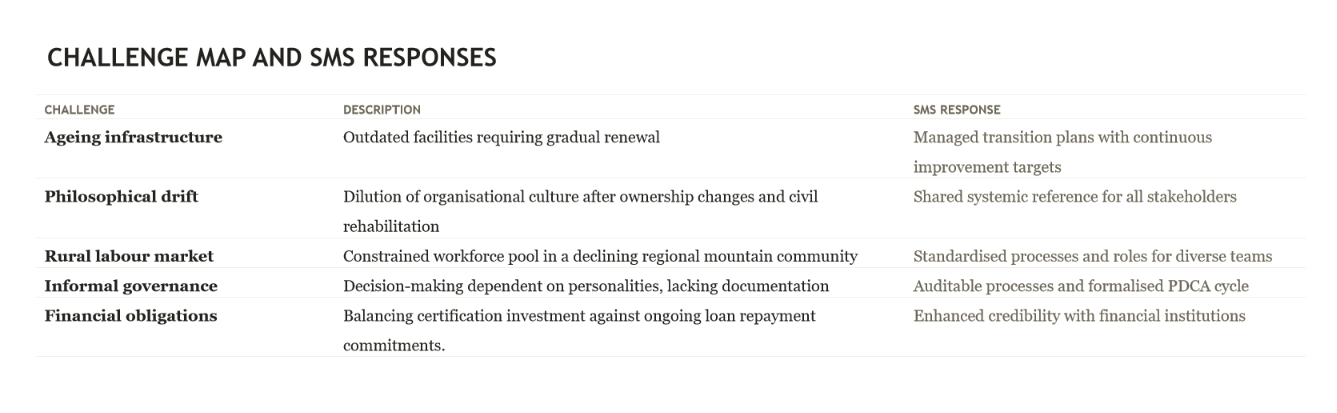
The hotel’s facilities had aged considerably. Guest rooms were outdated. Public areas no longer matched contemporary demand. This is a common constraint for independent or regional properties, particularly those that have passed through financial distress. ISO 21401 does not require facilities to be new; it requires them to be managed with transparency and continuous improvement objectives. However, ageing infrastructure does increase the complexity of energy monitoring, water management, and occupational health and safety commitments.
4.2 Organizational Coherence After Disruption
Following the rehabilitation process and subsequent changes in management leadership under investment fund ownership, the organization’s corporate philosophy had become diluted. Multiple stakeholders with different expectations, backgrounds, and commercial priorities had shaped the company’s direction in ways that created inconsistencies in management priorities and decision-making. This is precisely the problem ISO 21401’s systemic approach is designed to resolve — it creates a shared reference for all stakeholders, regardless of ownership structure.
4.3 Human Capital in a Rural Labour Market
Recruiting and retaining employees in a rural mountain community is genuinely difficult, and it is becoming more so as Japan’s regional populations age and decline. The hotel’s workforce has also become more diverse, including international employees with different cultural expectations and workplace values. This makes standardisation of processes and roles simultaneously more challenging and more necessary.
5. What Changed — and How
The most significant organisational shift reported by Nakazawa Village is one I consider the hallmark of successful SMS implementation: the transition from reactive, judgement-based problem-solving to systematic, evidence-based continuous improvement.
The introduction of risk assessments and the PDCA (Plan-Do-Check-Act) management cycle gave staff concrete frameworks for understanding not just what to do, but why. Transparency increased. Results — both positive and negative — began to be shared organisation-wide. The culture began to shift from compliance with instruction to genuine engagement with improvement.
We have shifted away from relying solely on personal effort or subjective judgment when responding to incidents, complaints or accidents. Instead, we now implement specific corrective actions and systematically monitor their effectiveness. Obtaining certification and strengthening our management systems have improved our reputation and credibility with financial institutions and other stakeholders.
— Mr. Nakazawa, President, Hotel Village (Nakazawa Village Co., Ltd.)
Employees developed clearer understanding of environmental responsibility, service standards, organisational goals and workplace risk. Guest satisfaction ratings from external surveys improved. And the improvements extended beyond the guest experience to relationships with financial institutions — a dimension of the standard’s value that is often underestimated.
When we focus on our local economy, local employment, community well-being and natural environment, our role becomes much clearer. We have come to strongly believe that maintaining our presence, continuing operations and ensuring that this property remains a vibrant destination rather than becoming abandoned are meaningful contributions to the local community and region.
— Mr. Nakazawa, President, Hotel Village (Nakazawa Village Co., Ltd.)
6. Measurable Results After ISO 21401 Certification
The results achieved following ISO 21401 certification in December 2024 are presented below. Data were provided by the President of Nakazawa Village Co., Ltd. and reflect the operational period subsequent to certification.
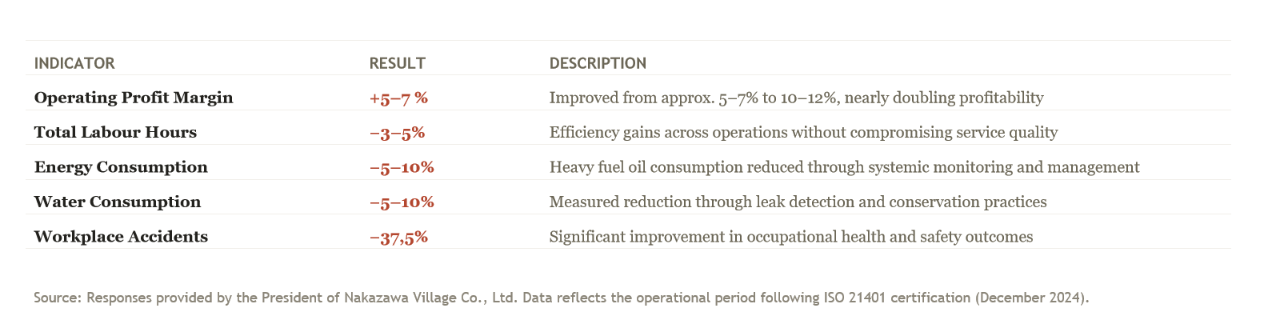
These results are not abstractions. They represent real operational efficiency, workers returning home safely at the end of each shift, and a financial margin that enables long-term planning. Sustainability management, done properly, improves the business case — not just the brand narrative.
7. The Road Ahead: SMS-Driven Investment Planning
Nakazawa Village’s forward planning illustrates another quality of mature ISO 21401 implementation: the sustainability management system does not end at certification. It drives investment decisions.
The hotel plans to replace key infrastructure — including boilers, air-conditioning and power systems that have been operational for nearly three decades — with an expected reduction of approximately 10% in electricity and fuel oil consumption. Water consumption targets exceed 10% reduction through comprehensive leak detection and conservation measures. Guest room renovations and facility upgrades are also planned, with a goal of sustaining operating profit margins at 10–12%.
Post-Certification Strategic Agenda
- Replacement of boilers, HVAC and electrical systems with nearly 30 years of operational life (target: −10% energy consumption)
- Comprehensive leak detection and water conservation programme (target: −10% water consumption)
- Guest room renovation and public area upgrades to align with contemporary demand
- Integration of SMS with Management by Objectives (MBO) across all management levels
- Strengthening of governance practices and process documentation
- Development of new business opportunities linked to local economic development
This is precisely what ISO 21401 is designed to generate. The PDCA cycle is not a reporting tool — it is a planning infrastructure. When implemented seriously, it connects capital expenditure decisions to sustainability outcomes, and sustainability outcomes to long-term organisational viability.
8. What This Case Teaches the Industry
The Hotel Village case demonstrates several things that practitioners and hospitality decision-makers should take seriously.
8.1 Scale Is Not a Prerequisite
ISO 21401 is not only for large resort chains or urban luxury hotels. A traditional Japanese ryokan-heritage property in a rural mountain community, carrying significant historical debt and operating in a constrained labour market, can achieve certification and meaningful operational results. What matters is not the size of the property, but the seriousness of the commitment to systematic management.
8.2 Value Alignment Is the Multiplier
The standard is most powerful when it is not imposed on an organisation’s identity, but allowed to structure what the organisation already believes in. Hotel Village did not need to be convinced that the local environment matters, or that employee wellbeing is a management responsibility, or that community ties are strategic assets. ISO 21401 gave them the discipline to act on what they already knew.
8.3 The Results Are Not Soft
Reduced fuel oil and water consumption, lower accident rates, improved operating margins and better standing with financial institutions are concrete commercial outcomes. Sustainability management, done properly, improves the business case — not just the brand narrative.
8.4 The Right Question to Ask
For accommodation operators who are still weighing the decision, the question is not whether ISO 21401 applies to you. The question is whether you are ready to build an organisation systematic enough to prove it.
9. Conclusions
ISO 21401 was designed to apply to any accommodation establishment, regardless of type, size or location. The evidence from Kusatsu Onsen reinforces that vision. A property that began as a traditional inn two centuries ago, survived civil rehabilitation in the 21st century, and now serves guests seeking both leisure and wellness, has found in this standard a management companion fit for its next chapter.
What the Nakazawa Village case demonstrates, above all, is that sustainability is not a constraint on performance — it is its enabling condition. When an organisation learns to measure what matters, to manage what it measures and to improve continuously based on what it learns, it does not merely comply with a standard: it becomes an organisation capable of honouring the past that shaped it and building the future its stakeholders deserve.
About the Author
Alexandre Garrido is the Convenor of Working Group 13 (Sustainable Tourism) within ISO/TC 228 and one of the principal architects of ISO 21401. He was instrumental in developing ABNT NBR 15401, the Brazilian standard that served as the foundation for ISO 21401, and has led the international technical work that brought this standard to publication.
References and Further Information
ISO 21401:2018 — Tourism and related services — Sustainability management system for accommodation establishments — Requirements
J-VAC — Japan Value-Added Certification: www.j-vac.co.jp
Hotel Village — Nakazawa Village Co., Ltd.: www.hotelvillage.co.jp
Alexandre Garrido: www.alexandregarrido.me