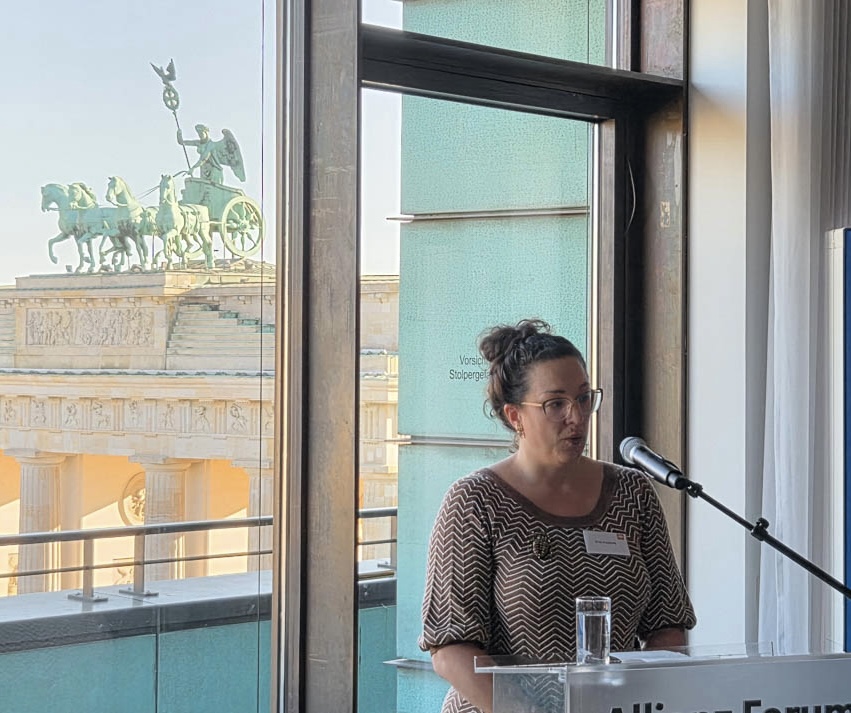
In an era of persistent disruption and interconnected risks, resilience is no longer optional — it is essential. In this opening speech, TC 292 Chair Ella Carlberg explores how international standards can strengthen society’s ability to anticipate, withstand, and adapt to crises, drawing on global trends and insights from Sweden’s Total Defense concept.
Opening speech
by Mrs. Ella Carlberg, Chair of ISO/TC 292 Security and resilience to the delegates at the 12th TC Plenary meeting in Berlin
29 May 2026
7 MIN READ
[Full speech]
Distinguished delegates, colleagues, and partners,
My name is Ella Carlberg, and it is my great privilege to address you as the newly appointed Chair of TC 292 at a moment when our work has never been more relevant — or more urgently needed.
Before I start, I want to take this opportunity to thank our gracious hosts at DIN, for arranging this event. Thank you for doing the heavy lifting, and providing us with such an excellent program! I also want to thank you all for the hard work you have put in this week. And a special thanks to the secretariat for all their support, both to me and to the whole group.
The overarching goal of this committee, as formulated by ISO's 2030 Vision, is "making lives easier, safer and better". But across regions and sectors, the global security environment is deteriorating in ways that are both familiar and fundamentally new. We are witnessing the convergence of geopolitical instability, climate-driven emergencies, cyber threats, supply chain disruptions, pandemics, and technological dependence. (And yes, despite all my reservations regarding technology — and this is a much broader conversation that I hope we will continue to have — I did indeed consult AI as I was writing this speech.)
These risks no longer emerge one at a time. They cascade, amplify one another, and expose vulnerabilities across borders, sectors, and systems.
What once were considered "exceptional events" are increasingly becoming part of our everyday operating environment. (You have all heard of "black swans" by now, and some of you may also have heard about the largely ignored, but equally challenging "gray rhino" events...)
For organizations, governments, and communities alike, the question is no longer if disruption will occur, but how prepared we are when it does.
What we are experiencing is a systemic shift: from a world of manageable crisis to a world of persistent disruption.
This reality places resilience — not as an abstract concept, but as a practical capability — at the center of sustainable security.
A World Moving from Stability to Strain
For many decades, security planning (particularly in industrialized societies) was shaped by assumptions of relative stability. Risks were assessed as improbable, localized, and time-limited. Efficiency was prioritized over redundancy. We replaced just in case with just-in-time.
Those assumptions no longer hold.
Recent years have demonstrated that disruption is neither rare nor predictable. The events we once considered "black swans" now occur with alarming frequency. Supply chains designed for efficiency fail under stress. Digital infrastructure becomes a strategic vulnerability. And the public's expectations for continuity, transparency, and accountability increase precisely when systems are most strained.
In other words: security is no longer about preventing every incident. It is about ensuring continuity under pressure.
That is the essence of resilience!
From Protection to Endurance and Adaptation
Traditional security approaches focus on protection: preventing harm, reducing exposure, and hardening assets. These measures remain necessary, but they are no longer sufficient.
Modern threats are adaptive and ambiguous. They exploit weaknesses in governance, coordination, and decision-making (in essence, our humanity) as much as physical or technical flaws. They unfold across domains: civil and military, public and private, national and international.
Resilience therefore represents a strategic evolution:
- The ability to anticipate disruption,
- To absorb shocks without catastrophic failure,
- To recover rapidly and responsibly,
- And to adapt and innovate, thereby learning from stress rather than merely surviving it.
This shift, from static security to dynamic resilience, is precisely the domain of TC 292!
Total Defense: A Swedish Perspective on Resilience
Allow me to ground this discussion in a concrete example that I have close at hand: the Swedish concept of Total Defense (Totalförsvar).
Swedish Total Defense is built on a simple but powerful premise:
In times of crisis or war, the whole of society must contribute to defense and resilience.
This means not only relying on the tip of the spear that is the armed forces, but bringing together:
- Civil authorities at all levels,
- Private sector operators,
- Critical infrastructure providers,
- Civil society organizations,
- And last, but not least, individual citizens. In Sweden, every individual between 16 and 70 has a civilian duty to contribute to total defense.
The aim is not militarization of society, but preparedness through integration.
Key principles of Total Defense include:
- Clear roles and responsibilities before crisis occurs,
- Strong civil preparedness supporting military defense,
- Continuity of essential societal functions under stress, and
- Ensuring trust, transparency, and shared situational awareness.
In recent years, Sweden has deliberately rebuilt and modernized this concept in response to a worsening security environment. We have broad political backing for this effort, and funds are flowing to allow us to lean in and accelerate a broad build up of capabilities. My home agency, the Swedish Civil Defense and Resilience Agency, has been tasked with leading and coordinating the development of our civil defense.
In this work, we are learning a lot from the hard earned lessons of our partners in Ukraine. As you may know, since this spring, I am stationed at our embassy in Kyiv to spearhead our work on lessons learned, and to chaperone the development of a system of innovation for civil defense.
In a remarkable way, Ukraine has been able to maintain the functionality of society and everyday life, while also innovating at breakneck speed! Later today we will hear from Vasyl Ananyev of the State Service of Special Communications and Information Protection of Ukraine (in the day to day we call them SSSCIP). Vasyl will share their experiences related to the protection of critical infrastructure under immense pressure, and opportunities for increased standardization in this area. I think the Ukrainian perspective is very important going forward, and this presentation will be highly interesting. Hopefully it will give you lots of great ideas for future work!
Standards as the Backbone of Total Defense Thinking
What is particularly relevant for us in TC 292 is how closely Total Defense aligns with the logic of international standards.
Total Defense depends on:
- Common terminology across sectors,
- Defined interfaces between organizations,
- Interoperable processes for risk management, continuity, and crisis response,
- Shared expectations of competence and preparedness.
These are exactly the functions standards are designed to serve.
TC 292 standards — covering a broad spectrum, including rescue services, business continuity, resilience, crisis management and supply chain security — provide the structural foundation that allows diverse actors to operate coherently under stress.
In effect, standards can help translate the philosophy of Total Defense into repeatable, scalable practice.
Resilience as Leadership Responsibility
One lesson from both deteriorating global conditions and the Swedish experience is clear:
Resilience cannot be delegated downward.
It must be a leadership responsibility.
Resilient systems are not created solely through technical controls or emergency plans. They are shaped by:
- Governance models,
- Strategic priorities,
- Investment decisions,
- Organizational culture.
Our standards need to increasingly reflect this reality by emphasizing:
- Top management accountability,
- Integration into core management systems,
- Continuous improvement based on learning and review.
In Sweden's Total Defense model, senior leadership (political, administrative, and corporate) are no longer expected only to plan for blue sky days or best-case scenarios, but for sustained disruption, including the ultimate disruption of war.
And even if the threats we face may differ, this shift in mindset is essential worldwide.
Deterioration Means Time Is a Critical Resource
Another defining feature of today's security environment is compressed decision time.
Crises escalate faster than bureaucratic processes can handle. Information is incomplete, contested, and rapidly evolving. Public scrutiny is immediate and unforgiving.
Under such conditions, resilience depends on pre-established frameworks — it cannot rely on ad hoc improvisation.
Standards matter because they enable:
- Faster coordination without negotiation,
- Trust without personal relationships,
- Action without ambiguity.
In Swedish Total Defense planning, exercises consistently show that the organizations that perform best are those that rely on tested, standardized processes, instead of individual heroics.
This insight is universal.
Bridging Civil and Military, Public and Private
A critical challenge in resilience-building is bridging divides:
- Between civil and military domains,
- Between public authority and private ownership,
- Between national responsibility and global dependency.
Total Defense explicitly addresses these divides by recognizing that societal resilience is indivisible. A resilient military requires resilient energy systems, communications networks, logistics flows, healthcare capacity, and public trust. In essence, armies don't win wars, societies do!
TC 292 standards support this integration by providing neutral, internationally accepted frameworks usable across sectors and jurisdictions.
They allow for example a private logistics provider, a municipal authority, and a national agency to plan for continuity using the same conceptual model, even if their mandates differ.
Resilience in an Era of Hybrid Threats
The deteriorating security situation is also characterized by ambiguity.
Hybrid threats blur the line between peace and crisis, accident and attack, influence and information. They test legal frameworks, institutional mandates, and public confidence.
We all need to be prepared for prolonged periods of elevated tension, where society must function under pressure without clear thresholds for escalation.
This reinforces the importance of resilience as a sustained capability, and not a temporary emergency posture.
Our standards can help organizations operate effectively in this "grey zone" by emphasizing continuity, adaptability, and decision-making under uncertainty.
The Role and Responsibility of TC 292
With this context in mind, the responsibility of our committee is substantial.
We are not merely maintaining documents. We are poised to shape the practical grammar of global resilience, including:
- How risks are understood,
- How responsibilities are assigned,
- How preparedness is measured, and
- How recovery is judged.
Our standards influence real-world decisions affecting:
- Public safety,
- Economic continuity,
- Societal stability,
- And ultimately, trust in institutions.
In a deteriorating security environment, clarity, usefulness, and credibility are not abstract virtues — they are operational necessities.
A Call for Continued Ambition
Allow me to conclude with a call to action.
The worsening security environment is not a temporary deviation. It is a long-term condition. Resilience must therefore be embedded, maintained, and continuously improved.
Drawing on experiences such as those in Ukraine, and on the collective expertise within this committee, we have the opportunity, and the obligation, to ensure that our standards remain:
- Relevant under stress,
- Practical in implementation,
- Accessible across sectors and nations,
- And forward-looking in the face of uncertainty.
Resilience is not about resisting change. It is about enduring it — together!
Let us continue our work with realism about the risks, confidence in the value of standards, commitment to strengthening resilience and making lives easier, safer and better worldwide. And let us meet this challenge with humble audacity about what we can achieve together!
Thank you.