Standards for unity in an uncertain world
The world grew more complex in 2025. Global instability, emerging technologies and environmental pressures all underscored a simple reality: no country or organization can tackle today’s challenges alone. That spirit of collaboration was reflected throughout the year and came into sharp focus at the ISO Annual Meeting 2025 in Kigali, Rwanda, where members from around the world gathered under the theme “United for impact”.
Collaboration was the hallmark of 2025. Through high-level partnerships, global convening and targeted engagement in multilateral processes, we strengthened the role of International Standards as critical enablers of responsible AI, climate action and sustainable development.
Discover how we united for impact in 2025.
Jump to:
ISO in figures
ISO members
new standards
International Standards and related documents
new work items were registered
Highlights
AI and emerging technologies
As the narrative around artificial intelligence shifts from the technology itself to its responsible governance, ISO was at the heart of the debate. At landmark events such as the World Economic Forum in Davos, the AI Standards Hub in London and the AI for Good Global Summit in Geneva, we highlighted how International Standards enable responsible AI governance that supports innovation and protects societal values.
Across all three events, a common message emerged: International Standards are the mechanism that makes cooperation possible in a digital world.
- World Economic Forum – Positioned International Standards as catalysts for global “collaboration in the intelligent age”.
- AI Standards Hub – Advanced the case for globally harmonized, socio-technical AI governance built on trust and underpinned by standards.
- AI for Good Global Summit – Showcased how International Standards support emerging AI regulation across borders; this was reinforced by the launch of the AI Standards Exchange Database, a one-stop gateway to AI standards.
The AI for Good Global Summit also delivered concrete outcomes. Along with our World Standards Cooperation partners IEC and ITU, we launched two flagship papers to advance the responsible governance of AI-generated content. The first mapped the standards related to digital media authenticity, while the other equipped policymakers with guidance on using International Standards to shape regulation for synthetic multimedia content. Together, they help lay the foundations for a more trustworthy digital ecosystem.
The year culminated in the 2025 International AI Standards Summit in Korea, a joint initiative between ISO, IEC and ITU that served as a platform to drive the global conversation on AI design, governance and International Standards.
The Summit saw the announcement of the Seoul Statement, which sets out a joint vision and commitments for how International Standards will help shape the responsible development of AI. For ISO, this marks an important step forward, recognizing that trustworthy AI depends not only on technology, but also on the people, institutions and governance frameworks that standards help support.
Climate, biodiversity and circularity
As the triple planetary crisis of climate change, biodiversity loss and pollution intensified, International Standards increasingly became the means of turning environmental ambition into practical action. Across all these areas, ISO helped equip organizations and policymakers with the tools needed to deliver measurable progress.
A defining milestone was the launch of ISO 17298, ISO’s first International Standard dedicated to biodiversity. Introduced at the ISO Annual Meeting in Kigali, it provides organizations with a practical roadmap for embedding nature into strategy and decision-making. Speaking at the event, Rwanda’s Minister of Environment, Hon. Bernadette Arakwiye, captured the urgency of the challenge with a powerful call to action:
“Biodiversity sustains our food, water, climate and economies. Humanity must end its war against nature and work together to restore our ecosystems.”
The transition to a circular economy also gained momentum. We recognized the global impact of ISO/TC 323, ISO’s technical committee on circular economy, with the prestigious LDE Award. Through its work, the committee is driving a sustainability revolution by developing standards that make circularity practical, measurable and scalable across industries and borders.
The focus on implementation was equally evident on the global stage. At COP30 in Belém, ISO joined forces with IEC and ULSE (UL Standards & Engagement), supported by 18 partners, to host the Standards Pavilion, demonstrating how International Standards transform climate ambition into measurable action.
This was the year that International Standards were recognized not simply as background infrastructure, but as essential implementation tools, as the COP30 Action Agenda explicitly acknowledged their role in scaling solutions faster, more cost-effectively and with greater credibility across countries.
Effective environmental action also depends on reliable data. At the UN Environment Assembly (UNEA-7) in December, ISO highlighted how International Standards provide the trusted, comparable data needed for good environmental governance. Together with Standards Australia, we showcased the new environmental standards dashboard, giving policymakers and organizations easier access to the standards that support environmental action.
Strategic partnerships
The ISO Annual Meeting in October brought together the global standards community under the theme “United for impact”, reflecting our conviction that meaningful change comes from combining strengths across borders. The event saw the signing of the Kigali Agreement on enhanced technical cooperation between ISO and ARSO, establishing a framework to accelerate the adoption and impact of International Standards in Africa.
Other powerful examples of collaboration included the ISO and GHGP Protocol partnership to harmonize our existing portfolios of greenhouse gas standards and co-develop new standards. This is a major step towards a common global language for greenhouse gas emissions accounting and reporting, accelerating progress towards decarbonization.
Another key milestone was the launch of the ImpactWorks Alliance in July, in partnership with the United Nations Development Programme (UNDP). The Alliance provides a platform to support the implementation of forthcoming joint management system standards related to the Sustainable Development Goals, translating global ambitions into operational outcomes for organizations worldwide.
We also teamed up with the Permanent Mission of Iceland at the 58th United Nations Human Rights Council to launch the world’s first international guidance for child-friendly multidisciplinary and interagency response services. Developed with a broad coalition of international partners, the new framework helps governments and frontline services work together more effectively, ensuring child victims of violence receive coordinated, trauma-informed care and protection.
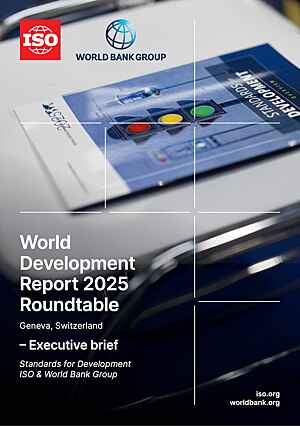
A defining moment for International Standards
The World Development Report 2025 marked a milestone for the international standardization community. For the first time in its 45-year history, the World Bank dedicated its flagship annual report to standards, recognizing them as essential drivers of economic growth, innovation, trade and sustainable development.
ISO joined the World Bank to launch the report in December 2025 and, the following month, co-hosted a high-level roundtable in Geneva to explore how standards can serve as core development infrastructure and help turn global ambitions into practical action.
Read the reportFinances
Here are the main figures, with the previous year given for reference.
Financial performance (kCHF)
| Operating revenue | 2025 | 2024 |
|---|---|---|
| Membership fees | 22 306 | 22 646 |
| Royalties received from members selling ISO standards | 14 841 | 14 936 |
| Revenue from members | 37 147 | 37 582 |
| Revenue – net sales | 7 618 | 7 028 |
| Funded activities | ||
| Funds to support capacity-building activities | 2 529 | 2 738 |
| Funds to support the ISO Strategy | 2 045 | 2 525 |
| Funded activities – revenue | 4 574 | 5 263 |
| Total revenue | 49 339 | 49 873 |
| Operating expenditure | 2025 | 2024 |
|---|---|---|
| Operations | 41 959 | 44 570 |
| Funded activities | ||
| Capacity-building activities | 2 529 | 2 738 |
| Implementation of the ISO Strategy | 2 045 | 2 525 |
| Funded activities – expenditure | 4 574 | 5 263 |
| Total expenditure | 46 533 | 49 833 |
| Operating result | 2 806 | 40 |
| Financial gain | 919 | 1 758 |
| Extraordinary charges | -100 | -420 |
| Net result before allocation to/dissolution of funds | 3 625 | 1 378 |
Balance sheets as of 31 December (kCHF)
Assets
| Current | 2025 | 2024 |
|---|---|---|
| Cash and cash equivalents | 6 451 | 12 096 |
| Receivables, prepaid expenses and accrued income | 6 182 | 3 778 |
| Total | 12 633 | 15 874 |
| Non-current | 2025 | 2024 |
|---|---|---|
| Securities and investments | 24 008 | 22 731 |
| Rent guarantee for ISO Central Secretariat premises | 648 | 655 |
| Fixed assets | 153 | 169 |
| Total | 24 809 | 23 555 |
→ 2025 total assets: 37 442 kCHF
Liabilities
| Current | 2025 | 2024 |
|---|---|---|
| Suppliers and accrued liabilities | 3 775 | 4 485 |
| Members’ retrocessions | 2 749 | 3 051 |
| Revenue received in advance | 1 501 | 1 884 |
| Total | 8 025 | 9 420 |
| Funds | 2025 | 2024 |
|---|---|---|
| Restricted funds | 2 693 | 5 532 |
| Unrestricted funds | 23 099 | 23 099 |
| Net result before allocation to/dissolution of funds | 3 625 | 1 378 |
| Total | 29 417 | 30 009 |
→ 2025 total liabilities: 37 442 kCHF
Summary of cash flow statements (kCHF)
| Net cash | 2025 | 2024 |
|---|---|---|
| Net cash used in operating activities | -3 887 | -2 192 |
| Net cash used in capacity-building projects | -794 | -950 |
| Net cash from (-used in) investing activities | -964 | 104 |
| Decrease in cash and cash equivalents | -5 645 | -3 038 |
| Control | 2025 | 2024 |
|---|---|---|
| Cash and cash equivalents at the beginning of the period | 12 096 | 15 134 |
| Cash and cash equivalents at the end of the period | 6 451 | 12 096 |
| Difference | -5 645 | -3 038 |
Principal officers
The principal officers were the people navigating ISO towards its strategic goals in 2025. You can find out more about each of them in their detailed bios.

Republic of Korea

ISO Central Secretariat

Argentina

Germany

Switzerland

Spain
End of term of office is displayed after the role. Past principal officers of ISO is available as a PDF.